Promises MAde
“There is no personal security and here is no personal protection for the rights of these men; and the question is whether we will allow them to be the prey of that disorder, or whether the Government of the United States will interpose its authority in their behalf.”
988 Mr. Morrill
In the early days after the Civil War ended, there were many promises made by the Federal sector on how conditions would change for newly freed Black citizens. Many, including radicals and more moderate liberals saw the necessity for Federal support in the integration of former slaves into the wider community

“...in the sudden change from slavery to freedom there must be a great many black people who require assistance from us1..”  (985) (Mr. Conness)
“There is no personal security and here is no personal protection for the rights of these men; and the question is whether we will allow them to be the prey of that disorder, or whether the Government of the United States will interpose its authority in their behalf, mediate between them and their former masters, and provide in some way that they shall have employment, that they shall have support, that they shall have protection2." (988) (Mr. Morrill)
“The freedman would be protected and guarded in every particular, and have all the rights that any man could have3…” (689) (Mr. Eliot)

Though there was some difference in the reasoning behind this, some saw Black people as being unfit to have total control over their circumstances, others understood the circumstances which made it nearly impossible for Black people to succeed in the South (though some certainly did).

“ We are committed, according to my understanding of the case, to some provident care and supervision over this helpless, dependent class of persons4.” (988) (Mr. Morrill)
“We have no doubts of the aptitude of the slave for freedom under any fair circumstances5." (690) (Freedman’s Aid Societies in Boston, NY, Philadelphia, and Cincinnati)

Or even simply as punishment for the rebel states.

“My opinion is that whenever a State undertakes to rebel, and to violate a single law of the United States, it is the duty of the Government of the United States to coerce that State, and force her obedience, even at the point of the bayonet.” (237) (Mr. Smith)

Most prominently freedom was promised to newly freed Blacks, that they would never be forced into the same labor practices.

“Involuntary servitude is forever prohibited, and freedom and equality of civil rights before the law are guaranteed to all persons in said State.” (281) (H. R. No. 602)

The promise was also made that Black citizens would be able to vote, that the American promise of ensuring just treatment through democracy would apply to Black people.

“I think that we should deal justly with the unfortunate class of people who will be freed by the adoption of this amendment. Justice, long delayed, should be awarded to them.” (201) (Mr. Farnsworth)
“I am not, sir, one of those who believe that the emancipation of the black race is of itself to elevate them to an equality with the white race… but I would make every race free and equal before the law…” (155) (Mr. Davis)
“I would make them free under the law; I would protect them in the courts of justice; if necessary, I would give them the right of suffrage, and let loyal slaves vote their rebel masters down and reconstruct the seceded states; but I wish to have no system of guardianship and pupilage and overseership over these negroes.” (985) (Mr. Lane)
“I want no senseless rule that allows a fool or a scoundrel to vote if he be white, and excludes a wise and an honest man if he be black.” (291) (Mr. Kelley)

One of the primary ways of enforcing the early promises made by Congress was the Freedman's Bureau. There was much infighting in Congress on whether the Freedman's Bureau should exist, and how much power it could be allowed. Especially under the Johnson Administration, as Andrew Johnson was committed to diminishing its power as much as he could. With all its flaws and limited abilities, for a short time the Bureau was an institution committed to improving conditions for Black citizens. And certainly, it was perceived that way.
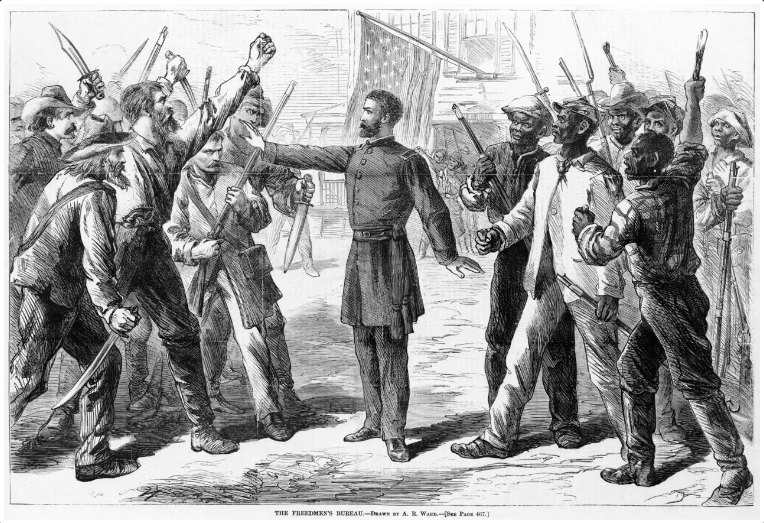
Illustration from 25 July 1868 edition of Harper’s Weekly https://www.harpweek.com/09Cartoon/BrowseByDateCartoon.asp?Month=July&Date=25
Failing to meet expectations
Though the Republican party held a strong majority, especially once the seceded states forfeited their representation, they were still unable to make the radical changes that were promised to Blacks.

“However inadequate as a response to the legacy of slavery, it remains a tragedy that the lofty goals of civil and political equality were not permanently achieved.” (279)
In spite of attempts from Black people to aquire aid and protection from the Federal Government, overall Congressional actors were too afraid of overstepping their authority. Some actions were made to force the South into compliance, but in the interest of unity, they allowed Southern dissidents to face few consequences.

"He thought the slaveholding elite and federal officials overseeing emancipation should “have given us something when we were freed.” (9)
“We cannot get protection unless we have assistance from the government” (195)
“African Americans told their stories of world-unraveling violence and asked federal officials and their fellow citizens to respect their rights. But the will to protect Black people’s freedom was in diminishing supply.” (211)
“But it suggests to my mind another objection raised by the gentleman from Kentucky, and that was, that we proposed to interfere with the local affairs of those States, such as marriage, and all civil rights of citizens thereof. Sir, we propose no such thing. Those are questions which must depend upon the action of the local authorities of the States, and we interfere with them in no manner whatever.” (1000) (Mr. Wilson)
“For that Union I am ready to give up every resentment, to forget every sacrifice that the North has made, and to ask the people of the South to come back into the Union with those principles of freedom which shall make and which alone can make the Union perpetual.” (155) (Mr. Davis)
“We must be prepared to make still greater sacrifices than any that have gone before, if necessary” (178) (Mr. Ward)
“For I regard the preservation of these (Constitution and Union) as paramount to and far higher than any question affecting the freedom or slavery of the African race upon this continent.” (258) (Mr. Rollins)

What little action was successfully taken by the Federal Government was undercut by Black Codes and Jim Crow Laws. Congress mostly focused on aquiring the vote for Black men, which wasn’t sufficient to match promises made, but also was not accomplished in full.

“But the vote wasn’t a substitute for the federal government’s responsibility to uphold Black citizens’ rights to life, liberty, and the pursuit of happiness.” (xxiii)
Black Codes
When the Civil War ended the South didn’t just accept the rules, they fought back. Though many radicals in Congress saw the Black Codes for what they were, it was still exceedingly difficult to rid the country of them.Read more:
“Slavery must be abolished not in form only but in substance, so that there shall be no Black Code; but all shall be Equal before the Law.” (91) (Mr. Sumner)
“But these old slave codes still exist; they are executed in four fifths of the rebel territory today, and four or five of those States are passing other codes inhuman, unchristian, and inconsistent with the idea that these freedmen have rights.” (41) (Mr. Wilson)
“It has been said that the slave codes and the laws of these States in regard to persons of color fell with slavery, but in fact those laws are being executed, and in some of them in the most merciless manner. In several of these States new laws are being framed containing provisions wholly inconsistent with the freedom of freedmen.” (40) (Mr. Wilson)
(1866) Texas Black Codes • (blackpast.org): Congress
Reconstruction Overthrown
Regardless of the many different outcomes that could have come from the process and era of Reconstruction, it would be a vast oversimplification to say that Reconstruction failed, or that under the leadership of Lincoln, the state of race relations in our country would be more equitable. Although some Radical Republicans, and many dedicated Black citizens fought for equality, and worked to gain their own wealth and opportunities, the Southern power structure, and nation-wide views on Black rights fought back. It was not simply a failure to dismantle long-standing systems in the South, Southern powers struggled to continue to oppress the Black community and confiscate their hard-earned property. Whether Lincoln’s death was the deciding factor that allowed the confederate states to commit both heinous political and incomprehensible physical crimes against their Black citizens we will never know. But we can understand that the situation Black Americans face today is inextricable from the history of violence that began with the slave trade, but certainly did not end when it did.
“Government entities bear some responsibility for Reconstruction not living up to its promises, certainly. But this “failure” narrative erases the story Black Americans like Edward Crosby told about Reconstruction: it did not simply fail, white conservatives overthrew it.” (xxi)